Solderball Pin™ Technology Streamlines Production and Conserves PCB Sp…
페이지 정보

본문
Automation-ready, discrete components offer design flexibility and facilitate SMT reflow while eliminating coplanarity issues. New connector designs leverage solderball pin technology to optimize board-to-board and specialized interconnect arrays including connections between daughter boards and a central motherboard.
The growing use of multi-board modular product designs across a widening range of electronics applications is driving the need for advanced interconnect technologies that can deliver a high degree of design flexibility and soldering efficiency, while also leveraging high-speed automated production processes.
The use of daughter-board modules offers numerous advantages such as:
Enhanced configuration flexibility with module-based options
Improved thermal management by segregating heat-generating components
Production and logistics efficiency by building/stocking at sub-assembly levels
Opportunities for sub-contractor production of many module-level assemblies
Length and width dimensional reduction of main/mother board
To maximize these advantages, designers and manufacturers need interconnect solutions that conform with industry-standard SMT processes while simultaneously overcoming the challenging coplanarity issues that can be roadblocks to consistently achieving reliable inter-board surface mount connections.

Originally pioneered by Autosplice, discrete Solderball Pin™ Technology incorporates precisely-formed spheres of RoHS-compliant solder on high-current carrying copper terminals packaged in continuous tape-and-reel automation-ready formats.
Available in a variety of different configurations, pin-lengths and materials, Solderball Pins can be integrated into virtually any daughter module, with the solderballs then providing a standards-based SMT interface for subsequent parallel assembly of the daughter-board to the mother-board. Currently available standard products include through-hole, SMT and SMT High Power pin styles, with stack heights ranging from .100 to .170 inches and pin diameters from .033 to .070 inches. This makes the technology ideal for a wide range of printed circuit boards, especially in compact modular designs.
During final assembly and reflow, the Solderball Pins also provide auto-compensation for coplanarity differences between the PCBs, enabling the daughter module to settle onto the main board and assuring consistent formation of solder fillets for all pins. This process integrates seamlessly with the reflow soldering process, where solder paste is used to achieve reliable, conductive joints between components. With non-coplanar boards, some solderballs will compress while others will columnize, in each case ensuring a robust solder joint.

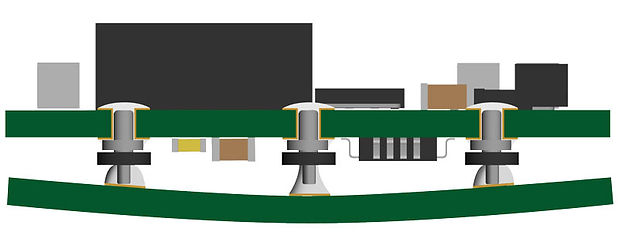
As discrete auto-placeable components, Solderball Pins also give PCB designers the freedom to determine the optimal pattern and positioning of individual interconnects based on specific application requirements while maintaining convenient service access to surrounding components and circuit areas when required. Discrete Solderball Pins also allow for designers to optimize PCB trace layout and shorten electrical path lengths. This flexibility contributes to a more efficient PCB assembly process, helping reduce errors and manufacturing costs. In addition, for products being migrated to high-speed SMT processes, using Solderball Pins allows for layout consistency between new SMT versions and through-hole legacy versions to provide a smooth transition.
첨부파일
-
01.avif (8.1K)
9회 다운로드 | DATE : 2026-08-14 08:36:37